
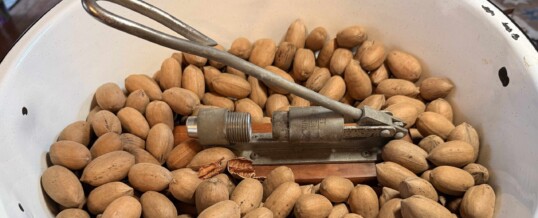
A ceramic dishpan, a lot of pecans, and a nutcracker made in Little Rock. When we saw those three things sitting in my dad’s lap, we knew we’d hear the cracking of pecans for days afterward.
My dad’s recliner sat beside the bay window in the living room of our red brick house on Beech Street in Ashdown, Arkansas. He liked it there because of the extra light, but also because he could watch the world go by.
The extra light came in handy as he cracked pecans and then worked to remove any additional unwanted debris from the meat of the nuts. Often, he used his Case pocketknife, but a dental scaler (what dentists use to clean teeth) later found its way into the process.
In the South, pecans are a staple used in everything from salads to cakes and pies. Especially pies. Where I come from, pecan pie is a food group.
We judge people who can’t make a pecan pie. We especially judge people who cannot properly say pecan.
The correct way to say it is, “puh-con.” If someone says, “pee-can,” we point them toward a restroom. There’s no room for saying pecan wrong in these here parts.
Each fall, those who grew pecans would connect with those who shelled them. Often, this occurred at church.
Pecan Grower: “Mary, tell your husband the pecans are on the ground, and ask him if he’s ready to come pick them up.”
My Mom: “He’s ready. I’ll send him tomorrow.”
Dad may have been the one to shell the pecans, but mom ran the show.
My father would load my sister, our cousins, and me, into his 1963 Ford Falcon, and off we’d go to the pecan orchard. We picked up pecans and put them into Piggly Wiggly paper sacks. And we did it – All. Day. Long.
We hauled bags of pecans back to the car and then dad loaded them into the trunk. When we got home, the kids went outside to play. Dad went to work.
One of the Piggly Wiggly sacks was placed next to his recliner, and the white, ceramic dishpan in his lap.
And it began.
In between the dialogue on the television, the sound of dad’s hand slapping the handle on the nutcracker provided the tempo for the day. Like a good drummer, dad kept the rhythm.
He had a clean bowl where he’d drop the shelled and cleaned nuts. When it filled, he’d call mom, who would come get the full bowl, replace it with an empty one, and she’d refill his coffee.
This process continued hour after hour, day after day, until all of the pecans were gone. Sometimes, that took awhile. But that was just fine. It appeared to be therapeutic to both mom and dad. He was getting something done. Something valuable. And mom knew she’d have lots of pecans for whatever she decided to do with them.
Times being what they were for folks, nothing was wasted. The pecan shells were distributed to family members to be used for everything from kindling in the fireplace or woodstove, to flavoring in the smokehouse where meats were cured, to scratch material mixed into the chicken feed, to compost and garden mulch.
The shelled pecans were then distributed.
The women in the family received their share, and so did church family members. Often, the two were the same. Many of our family went to the same church.
And so went the pecan cycle. Each fall, they fell. We picked them up, dad shelled them, mom bagged them, and often, the same folks who owned the pecan trees received their pecans back all nice and ready to use in a Thanksgiving or Christmas pecan pie.
The idea was to get you to do your part and to support those who support you.
It still is.
Today, I don’t know anyone who owns an orchard, but I do look for pecans for sale. Recently, I bought 18 bags of them. I’ve started shelling them and have the first two pounds finished. But I’m a long way from being done.
When I’ve cracked the last one, my wife will decide who gets pecans. In the meantime, she’s bringing me coffee, and I’m trying to keep the rhythm of the Little Rock-made nutcracker that was my dad’s. It’s sitting in the white, ceramic dishpan, which is in my lap.
And the happiness that comes from continuing a tradition that pleases so many is still around. Hopefully, for a long time to come.
© 2026 John Moore
John’s, “Puns for Groan People” and two volumes about growing up in the South called, “Write of Passage,” are available at TheCountryWriter.com. John would like to hear from you at John@TheCountryWriter.com.
FEB
2026