
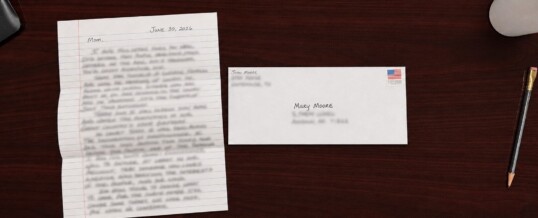
When I was about 10, I wrote a letter to my aunt, who lived in Oklahoma. I’d never written a letter to anyone before.
For a kid in Ashdown, Arkansas, Oklahoma might as well have been China.
I just knew that I didn’t see her or my uncle much, and I told my grandmother I missed them. She suggested I write them a letter. So I did.
That is, I wrote a letter after my grandmother got out her good stationery, envelopes, and stamps.
Stationery used to be serious business. Some people got boxes of it that were nice, while others picked paper stock they liked and had a printer put their name and address on it.
Normally, they’d pick a pretty or serious-looking font. Whatever reflected how they wanted to come across to the recipient.
My grandmother had store-bought stationery. Didn’t have her name on it, but if you received anything on that stationery, you recognized it was from her.
Had I not known about stationery, I would’ve sent a letter on paper from my Big Chief tablet.
I asked my grandmother what I should write in the letter. She told me that letters were conversations. They were one-sided, when you sent the letter and if the person wrote you back (which was expected), they’d continue the conversation by responding to what you’d written.
Calling on the phone seemed easier, and it was. But calling someone outside the area of where you lived was long distance, and long distance wasn’t cheap. You paid by the minute, and it could cost $1 to $3 every sixty-seconds.
So, a letter was the obvious choice.
My grandmother told me to write the way I talked. Tell them what I’d been doing, ask how they were, and don’t worry about sounding important. A letter wasn’t a school assignment. It was simply a visit on paper.
I wrote carefully, pressing hard with my pencil. There wasn’t a delete key. If I made a mistake, I erased until the paper got thin or started over. When I finished, my grandmother corrected a misspelled word, showed me where to sign my name, folded the letter neatly, sealed the envelope, and handed me a stamp. That little stamp somehow made the whole thing official. Then we walked to the mailbox.
Dropping that envelope through the slot felt like sending it on an adventure. I had no idea where it went after that. Somewhere, strangers sorted it, loaded it onto trucks, and eventually it found its way to my aunt’s mailbox in Oklahoma.
Then came the waiting. A couple of weeks later, she wrote me back on Snoopy letterhead. She loved Peanuts. I still have that letter.
Today, people send a text and wonder why someone hasn’t answered in five minutes. Back then, you waited days for your letter to arrive, then several more hoping one would come back. It taught patience whether you wanted to learn it or not.
When the reply finally arrived, it was exciting. Before you even opened the envelope, you recognized the handwriting. Somehow you could almost hear the person’s voice as you read the words. Their personality seemed to come through in every line.
The best part was that letters stayed with you.
People tucked them into dresser drawers, cigar boxes, or shoeboxes. Years later, you could unfold those same pages and revisit a moment in time. If the person who wrote the letter was gone, you still had something they had touched, something they had written, and something they wanted you to know.
Text messages disappear into phones.
Emails get buried in inboxes.
But handwritten letters have a way of surviving. They become family history without anyone intending them to.
I don’t remember exactly what I wrote to my aunt. It probably wasn’t anything remarkable. But I remember what my grandmother taught me that afternoon.
A letter isn’t really about paper, stamps, or stationery. It’s about taking enough time to let someone know they’re worth hearing from.
That’s something worth writing home about.
© 2026 John Moore
John’s, “Puns for Groan People” and two volumes about growing up in the South called, “Write of Passage,” are available at TheCountryWriter.com. John would like to hear from you at John@TheCountryWriter.com.
JUL
2026