
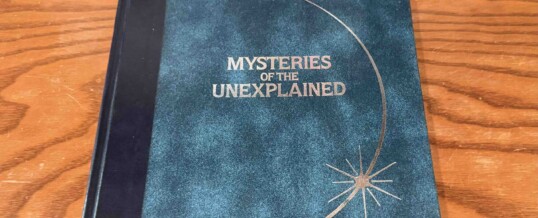
I’m not sure what fundraisers try to sell to grade school kids today, but when I was a kid, it was books. The school would hand out a pamphlet to each kid with a wide selection of books we could buy. Cheap.
Maybe these were books that didn’t sell somewhere else, or maybe they were just reprints of books that had sold before, but the other kids and I bought them. Lots of them.
They all were appealing to young people. Books by Beverly Cleary, Alfred Hitchcock, and science fiction from masters, including Isaac Asimov.
Income for kids in the 60s and 70s was limited to whatever you could earn by doing chores, mowing yards, or helping a neighbor.
So, that money was valuable. But I freely let some of it go for a compendium of scary stories or intrigue.
Looking back, I don’t remember anyone twisting my arm to read. The books simply looked interesting. The covers were colorful. The descriptions were exciting. Best of all, they belonged to me.
Once they arrived, usually a few weeks after we turned in our order forms, there was something special about seeing a stack of brand-new books with my name on them.
Teachers were smart enough to know that if a child is interested in what he is reading, he is far more likely to keep turning the pages.
Some kids liked mysteries. Others wanted books about sports, animals, history, outer space, or famous people. There were joke books, puzzle books, collections of ghost stories, and books that taught magic tricks. Nobody seemed overly concerned that everyone read the exact same thing. The important thing was that we were reading.
That lesson has stayed with me.
Some adults spend too much time worrying about whether a child is reading the “right” book. I have always believed that reading almost anything is better than reading nothing at all. A youngster who devours books about dinosaurs today may be reading biographies tomorrow. A child fascinated by model airplanes may eventually develop an interest in engineering. The path doesn’t matter nearly as much as developing the habit.
Reading opens doors that television, phones, and video games simply cannot. It stretches a child’s imagination because the pictures have to be created in the reader’s own mind. It expands vocabulary without feeling like homework. It quietly teaches grammar, sentence structure, and storytelling. Long before many children realize it, they’re becoming better communicators.
Those little book orders also taught us something about making choices. We had limited money, so we studied every page of those catalogs. We’d compare prices, count our dollars, and decide which titles would give us the biggest bang for the buck.
Sometimes a friend ordered a book we couldn’t afford, and after both of us finished reading, we’d trade.
The books often made the rounds through an entire neighborhood before finally ending up on someone’s bedroom bookshelf.
There was another benefit I didn’t appreciate until I was older.
Those book sales weren’t just about putting stories into children’s hands. They also helped schools raise money. Every order generated a little extra income that could be used wherever it was needed most. Those dollars often supported activities that tax money didn’t completely cover.
They helped buy uniforms for athletic teams, supplies for art classes, music programs, library materials, playground equipment, classroom projects, and dozens of other things that enriched school life. We probably never gave it much thought while filling out our order forms, but every paperback carried a small benefit that reached far beyond the student who bought it.
Looking back, that was a pretty clever arrangement. Kids received books they genuinely wanted to read, parents paid only a few dollars, and schools gained resources that benefited everyone.It’s hard to find fault with that formula.
Today there are countless ways to read. Books can arrive instantly on a tablet or phone. Libraries offer digital downloads. Audiobooks are everywhere. Those are wonderful advances, but I hope we never lose sight of the simple idea behind those old paper catalogs.
Give children something that interests them. Let them choose.
Don’t worry if it’s science fiction instead of history, mysteries instead of classics, or books about baseball instead of poetry. The love of reading rarely begins with assignments. It usually begins with curiosity.
For many of us, that curiosity arrived folded neatly inside a thin school pamphlet. We circled our choices, counted our money, and waited impatiently for delivery day.
When the box finally arrived in the classroom, it felt a little like Christmas.
The books may have been inexpensive, but what they gave us was priceless.
© 2026 John Moore
John’s, “Puns for Groan People” and two volumes about growing up in the South called, “Write of Passage,” are available at TheCountryWriter.com. John would like to hear from you at John@TheCountryWriter.com.
JUL
2026