
Southern folks don’t need proper nouns. We have whatchamacallits and thingamajigs.
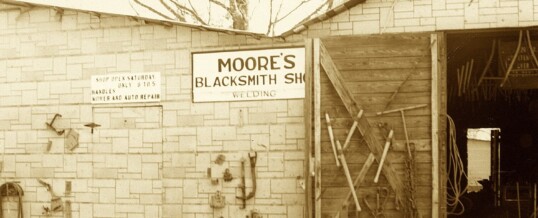
My grandfather had the only blacksmith shop in Ashdown, Arkansas. That’s where I learned the important terminology.
Papa’s shop, didn’t have labeled drawers. There were coffee cans. Each one held something useful, Bolts of every length, nuts that didn’t quite match anything, washers that had seen better days, and little pieces of metal whose original purpose had been forgotten somewhere around the Eisenhower Administration.
“Hand me that piece right there,” Papa would say, not even looking up.
If you hung around his shop long enough, you knew exactly which one he meant. I’d dig through the right can, rattling metal against metal, until I’d found the right one.
Things didn’t need their government name if everybody understood what you meant. A grocery cart was a buggy. And any soft drink on earth, no matter what the label said, was a Coke.
“What kind of Coke do you want?” somebody would ask.
“Dr Pepper,” might be the response.
The tool you couldn’t find yesterday but needed today was a doohickey. And the piece of equipment that had been patched, wired, and coaxed into service for the last 10 years was that old rig.
We didn’t lack vocabulary. We just didn’t waste it.
There’s efficiency to that kind of talk. You point, you nod, and you get to work.
In the corner of Papa’s shop, there was always an old percolator, working away to keep the energy up. You could hear it before you saw it, that steady perk-perk-perk sound, followed by the smell of coffee that had been working just as hard as Papa had. It was thick. A spoon could almost stand up in it.
Each time he wanted coffee, it was called something different. It was a “tin” one time and maybe a “hootis” the next.
Working on his old GMC truck always required coffee.
“What’s wrong with the pickup?” I asked.
“That little gizmo ain’t doing what it’s supposed to.”
That explained everything and nothing at the same time.
He reached in, loosened something, tapped something else with the handle of a screwdriver, and then nodded like the problem had finally admitted defeat.
“Crank it,” he said.
The engine turned over and settled into a steady rumble. This was when you could still fix your own vehicle.
“What was it?” I asked again.
He paused, thought about it, and then shrugged. “You know… the dingus was stuck.”
There’s a kind of trust wrapped up in words like that. You trust the other person to understand you, and they trust you not to steer them wrong. It’s the same trust that lets somebody say, “I’m fixin’ to head out,” and everybody knows they’ve got about five minutes before they’re actually gone.
Or when somebody says, “It’s over yonder,” and points in a general direction that might cover a quarter mile of territory. You don’t need a map. You just start and go.
Over time, those words become more than shortcuts. They become markers of where you’re from. You can leave a hometown, move to a city where everything is labeled and categorized, where aisles are numbered and parts are inventoried, and still find yourself saying, “Where’d I put that widget?”
And somebody nearby will either look at you like you’ve lost your mind, or they’ll nod and say, “You mean that piece over there?”
If they nod, you’ve found your people.
I’ve been in places where folks insist on the exact name for everything. They want the model number, the proper term, and the technical description. There’s nothing wrong with that, I suppose. It has its place. But there’s something to be said for a way of speaking that leaves room for memory and experience to fill in the blanks.
Because those filler words aren’t just forgotten names. They’re a shared understanding. They’re a lifetime of handing tools back and forth, of fixing what you have instead of buying something new, of making do and getting by.
It’s the sound of coffee cans rattling in a shop, the smell of hot metal, motor oil, percolator coffee, the low hum of a radio playing somewhere in the background. It’s a grandfather and a kid standing over an engine, not worrying about what something is called as long as it works.
And in the end, that’s the whole point.
You don’t always need the right word. You just need to know a doohickey from a thingamabob.
© 2026 John Moore
John’s, ”Puns for Groan People” and two volumes about growing up in the South called, ”Write of Passage,” are available at TheCountryWriter.com. Write a note to him at John@TheCountryWriter.com.
MAY
2026
