
There wasn’t anything accidental about blackberry season in our family. When harvest time came, dad had the harvest trip mapped out long before the berries ever ripened.
The same narrow country roads, year after year. Ditches, fence lines, and creek beds. None of them were the main roads in or around Ashdown, Arkansas. These were the back roads. Roads that originated as wagon paths in the 1800s, and wound their way through what just decades before had been thick, Little River County timber.
Roads my parents, their parents, and their parents’ parents all knew well.
Dad’s 1963 Ford Falcon provided the transportation. It wasn’t fancy, but it didn’t need to be. Mom would hand us a big bucket; the kind that seemed oversized when empty and never quite big enough once you got started. The assignment was simple. Fill it.
My sister claimed the front seat. I didn’t mind. I had my own spot in the back seat. It always felt as if we were driving into the past. I’d face backward and watch now turn into then.
There was something about that moment when the tires left the pavement and hit gravel. You could hear it before you felt it. A soft crunch, then a steady hum. Then came the dust. It rolled up behind us in thick clouds, hanging in the air like a signal that we were headed somewhere different, somewhere older.
Town gave way to country. From houses and storefronts, to fences, fields, and woods. And the edges of those woods held treasure.
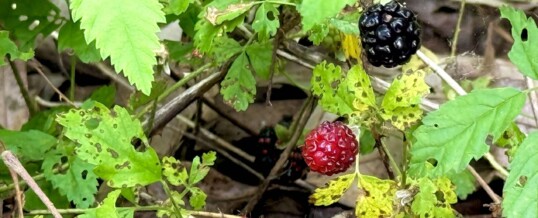
Dad didn’t waste time once he found the right stretch. He’d ease the Falcon off to the side, cut the engine, and step out. He knew exactly where to look. Along fencerows, at the edge of ditches, anywhere the sun hit just right. That’s where the blackberry vines took hold.
We’d spill out of the car and get to work.
There was no graceful way to pick wild blackberries. You reached in, careful at first, then less careful as you went along. The vines fought back with thorns that scratched your arms. You learned quickly to watch where you stepped. Snakes liked those same sunny edges. Ticks and chiggers were just part of the deal, even if you didn’t realize it until later. And poison ivy had a way of hiding right where you didn’t want it.
None of that stopped us.
The berries themselves were worth it. Deep purple, almost black, warm from the sun. Some went straight into the bucket, but plenty never made it that far. You’d pop a few in your mouth along the way, tasting that mix of sweet and just enough tart to make you pucker. It was the kind of flavor you couldn’t buy in a store.
Dad moved steadily down the line, never in a hurry, never wasting motion. He didn’t talk much while we picked, but he didn’t need to. Every now and then he’d point out a better patch or remind us not to miss the ones tucked underneath. My sister and I turned it into a quiet competition, each trying to outdo the other without saying so.
The bucket slowly filled.
Time had a different pace out there. No clocks, no schedules, just the sound of insects humming and the occasional rustle in the brush. The spring air still carried a little kindness to it. Not the heavy, pressing heat that would come later in the summer.
By the time we finished, our hands were stained and our arms told the story of where we’d been. Scratches, dirt, and sweat. But we didn’t dwell on that. We had what we came for.
Dad would take a look at the bucket, give a nod, and we’d load back up.
I’d turn around in the back seat again as we pulled away, watching the dust rise up behind us like it had when we came in. Only now it felt different. We weren’t just heading back home. We were bringing something with us. Something we had worked for.
Those berries didn’t stay berries for long. Mom would turn them into cobblers, jams, or jellies.
Hindsight, it wasn’t about the blackberries. It was about the roads, hours with two people I loved, and the way dad taught us without ever saying much. He showed us where to go, how to do it, and what it meant to stick with something. How to set and reach goals.
We never failed to fill the bucket with berries. Not once.
Today, my wife grows large, tasty blackberries from a cutting of her father’s blackberry bush in Ponca City, Oklahoma. He gave it to her over 20 years ago. Since then, many other family members and friends have received cuttings from her.
The best part is that we have both. Berries from her dad’s plant, and the wild blackberries that grow on our 10-acre homestead.
Each spring, I make my way around the fencerows on our land and fill the bucket. My arms show the scratches, and the ticks and chiggers find their way into places I wish they didn’t.
But it’s worth it. It always will be.
© 2026 John Moore
John’s, ”Puns for Groan People” and two volumes about growing up in the South called, ”Write of Passage,” are available at TheCountryWriter.com. Write a note to him at John@TheCountryWriter.com.
APR
2026